


Cambodia has voiced full support to Malaysia, this year’s ASEAN Chair, to make solving the Myanmar crisis a priority. This aligns with Cambodia’s own efforts to bring an end to the conflict, as shown during its chairmanship in 2022.
This was affirmed as the Kingdom is set to attend the ASEAN Foreign Ministers’ Meeting (AMM) Retreat in Malaysia, which is scheduled to be held from Jan 18 to 19 in Langkawi, according to the Ministry of Foreign Affairs and International Cooperation (MFAIC).
Malaysia, this year, assumed the ASEAN Chairmanship, marking the fifth time it has done so since the bloc’s establishment in 1967. The logo and theme, “Inclusivity and Sustainability,” were officially unveiled by the Malaysian Prime Minister Datuk Seri Anwar Ibrahim in October of last year.
The New Straits Times reported yesterday that Anwar said Malaysia as ASEAN Chair must prioritise finding solutions to key challenges, including the addressing of the Myanmar crisis, while ensuring that no member state will be left behind.
Chum Sounry, Secretary of State and Spokesman for the MFAIC, highlighted Cambodia’s readiness and commitment to solve the regional shared concerns, particularly the Myanmar crisis, for the sake of every ASEAN member.
“Cambodia stands ready to work closely with the current chair of ASEAN and all ASEAN member states in these endeavours to help Myanmar to return to normalcy as well as the ASEAN family,” Sounry said.
He highlighted that Cambodia also commends the efforts of the previous ASEAN Chairs and any complementary efforts by member states that contribute to finding a peaceful solution to the political crisis in Myanmar and in engaging with the numerous parties concerned to find a path toward inclusive dialogue and helping to deliver humanitarian aid to those most in need.
Sounry added that Cambodia as ASEAN Chair in 2022 managed to open the door slightly and established numerous key frameworks to facilitate the mobilisation and distribution of humanitarian assistance to Myanmar.
As ASEAN Chair in 2022, Cambodia endeavoured to promote the implementation of the Five-Point Consensus (5PC) adopted by ASEAN leaders to assist Myanmar in finding peace and stability and a return to normalcy based on a practical, step-by-step, and innovative approach, Sounry noted.
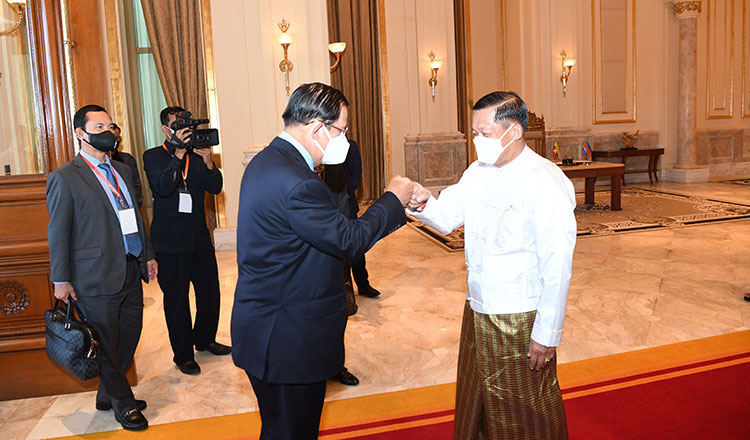
As chairman, then Prime Minister Hun Sen became the first national leader from an ASEAN member state to visit Myanmar since the military took power on February 1, 2021, and met Senior General Min Aung Hlaing, Chairman of the Myanmar’s State Administration Council in January 2022.
Prak Sokhonn, Deputy Prime Minister and Minister of Foreign Affairs and International Cooperation, in his capacity as the Special Envoy (SE) of the ASEAN Chair also visited Myanmar in March, and July 2022.
Thong Mengdavid, a geopolitical analyst and a lecturer at the Institute for International Studies and Public Policy (IISPP), said that Cambodia gained a distinct advantage in promoting advancements on the Five-Point Consensus during its tenure as ASEAN Chair.
“Cambodia’s prior chairmanship of ASEAN in 2022 and diplomatic engagements with Myanmar place it in a unique position to advocate for progress on the Five-Point Consensus (5PC), including humanitarian aid, dialogue, and ceasefire efforts,” he said.
Mengdavid underlined that such experience would allow Cambodia to smooth over differing opinions within ASEAN by pushing for constructive engagement without compromising ASEAN unity or non-interference principles.
“Given Samdech Hun Sen’s extensive experience and successful interactions with Myanmar’s leaders, he could help address the Myanmar crisis, enabling Malaysia to foster a confidence-building environment and encourage peaceful dialogue and negotiations with all parties involved in the conflict,” Mengdavid said. “The appointment comes at a time when he has been a pivotal figure in Southeast Asian politics for decades, with a profound understanding of ASEAN’s dynamics.”
He also noted that Cambodia’s participation in the AMM Retreat in Malaysia presents a strategic opportunity to advance its national interests, strengthen its influence within ASEAN, and navigate the dynamics of its bilateral relations with major powers.
“Cambodia can advocate for initiatives that promote regional economic integration, trade liberalisation, and infrastructure connectivity under frameworks like the ASEAN Economic Community (AEC), such as ASEAN-led investments in logistics, digital infrastructure, and green energy,” he said.
However, Maung Zarni, a Myanmar human rights activist well-known for his strong opposition to the violence in Rakhine State and the Rohingya refugee crisis, said that the Malaysian chairmanship won’t make a change if old patterns continued.
“The Malaysian chairmanship is not going to make any difference because even Indonesia, a much more powerful country or the largest of all ASEAN member states, failed to make any difference,” he stressed. “Partly because they are sticking with the totally futile and the impotent policy of the five-point consensus, and that needs to change.”
When contacted yesterday, Zarni who is based in the UK, indicated the areas that need adjustment to bring about meaningful change in the ongoing conflict in Myanmar.
“Their approach is too much of a state focus. The problem is when they treat the military junta as if it were the state, when it’s losing massive regions to the resistant forces, you create a scenario where ASEAN is seen to side with the military rather than to be the peace brokers,” said Zarni. “That needs to be changed fundamentally, or Malaysia will not make any difference.”

- Tags: ASEAN Chair Malaysia, Myanmar


